
Loading the lesson
Loading the lesson
Search AllRounder.ai
Search the courses, subjects, tracks, games and features, or jump straight to a page.
Search the courses, subjects, tracks, games and features, or jump straight to a page.
Learn it your way
A short class with Sarah and her students. The other ways are under More.
Sign up free to listen. Transcripts are free to read.

Today we're diving into the United Nations, an organization that plays a crucial role in international relations. Can anyone tell me when it was founded and why?

I think it was established after World War II in 1945 to prevent future wars.
That's right! It was founded to foster international cooperation and maintain peace. Remember October 24—it's celebrated as United Nations Day. What do you think are some main objectives of the UN?

To ensure peace and protect human rights?
Exactly! They also aim to encourage social development and provide humanitarian aid. Let's create a mnemonic to remember these objectives. How about 'PHESE' for Peace, Human rights, Social development, and Emergency aid?

I like that! 'PHESE' is easy to remember.
Great! So to recap, the UN was established in 1945 to promote peace and cooperation among nations, especially after the devastating effects of wars.

Next, let's talk about the main organs of the UN. Can anyone name one of them?
There's the General Assembly, right?
Correct! The General Assembly includes all member countries and discusses a variety of issues. How many members are there?
193 members!
Excellent! Now, does anyone know about the Security Council?

That’s the one with the five permanent members, like the USA and UK?
Exactly! They have veto power, which means they can block decisions. Let's remember these with the acronym 'SAGE': Security Council, Assembly, General assembly, Economic council. SAGE is wise and can guide us through the UN!
That's a clever way to remember them!
To summarize, the UN has several important organs, each playing a distinct role in the organization. We identified the General Assembly and Security Council and related them with memory aids.
Now, let's focus on the UN's specialized agencies. Who can name one?
The WHO, which deals with health issues.
Great! Who else?
UNICEF helps children!
That's correct! These agencies tackle specific global issues. A handy mnemonic could be 'WUC' for WHO, UNICEF, and ILO, which stands for the International Labour Organization. Can anybody tell me what ILO does?
They protect workers’ rights!
Exactly! In summary, specialized agencies ensure that the UN can address various humanitarian and developmental challenges effectively.
In this final session, let's address the achievements and challenges of the UN. Who can share an achievement?
They helped end colonialism in several countries!
Absolutely! The UN has also maintained peace through peacekeeping missions. Now, what are some challenges faced by the UN?
Sometimes countries don't cooperate well.
And the veto power can block decisions in the Security Council!
Good observations! To remember these challenges, we can use the acronym 'COW' for Cooperation, Options limited by vetoes, and Weak resources. What do you think about these challenges?
It's tough to ensure everyone cooperates when countries have their interests.
Exactly! In conclusion, the UN has made significant contributions to global peace and cooperation but continues to face real challenges that require reform and collaboration.
An international organization founded to foster peace and cooperation among nations.
The main deliberative body of the UN with all member states.
The organ responsible for international peace and security, with 5 permanent members.
Activities undertaken to help maintain peace in areas of conflict.
Support provided to those affected by crises such as disasters.
For peace and aid, the UN was made, in '45, help didn’t fade.
Imagine a world in chaos, where countries fight and people suffer. Then, a group of nations came together in 1945, determined to create a safe haven for cooperation. That’s how the UN was born, bringing hope to humanity.
Use 'PHESE' to remember the UN’s goals: Peace, Human rights, Social aid, and Emergency response.
Remember 'SAGE' for the main organs: Security Council, Assembly, General Assembly, Economic Council.
Term
What year was the United Nations established?
Click to flip
Term
What is the highest body of the UN consisting of all member states?
Click to flip
Term
What five countries have veto power in the Security Council?
Click to flip
Term
What does UNICEF focus on?
Click to flip
Term
What does the term 'humanitarian aid' refer to?
Click to flip
An international organization established in 1945 to promote peace, security, and cooperation among nations.
An organ of the UN where all member states participate in discussions and decision-making.
Responsible for maintaining international peace and security, consisting of 15 members.
The authority of the five permanent members of the Security Council to block any substantive resolution.
The deployment of international forces to help maintain peace in conflict areas.
Agencies under the UN that focus on specific issues like health, education, and labor.
Assistance provided to people in distress due to crises like wars or natural disasters.
Development that meets current needs without compromising the ability of future generations.
The United Nations (UN) is an international organization founded in 1945 to promote peace, cooperation, and human rights among its 193 member countries.
Founded after World War II, the United Nations serves as a global platform to address international issues such as conflict resolution, human rights protection, and economic development. It has various organs and specialized agencies to facilitate these goals.
The United Nations (UN) is a pivotal international organization established in 1945 aimed at fostering peace, security, and development globally. Today, it comprises 193 member states and operates from its headquarters in New York City. The UN addresses a variety of global challenges, including conflict resolution, human rights violations, environmental concerns, and economic development.
Prior to the UN, the League of Nations was formed after World War I to maintain peace but fell short due to limited membership and power. The catastrophic events of World War II led to the creation of the UN by leaders from victorious nations, who authored the UN Charter, which was signed in San Francisco on October 24, 1945. This date is now commemorated as United Nations Day.
The main objectives of the UN include:
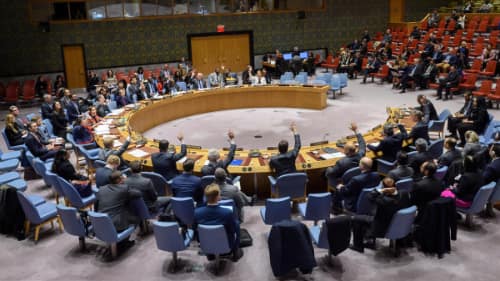


The UN is structured into six primary organs:
Various agencies support the UN's work, including WHO (health), UNICEF (children's aid), and UNESCO (education and culture).
The UN has successfully fostered decolonization, maintained peace in several regions, and raised awareness on critical issues, such as climate change. Nonetheless, it faces challenges, primarily from the veto power held by permanent members of the Security Council, limited resources, and criticisms regarding its effectiveness and need for reform.
Overall, the UN remains a cornerstone of global governance and international collaboration.