
Loading the lesson
Loading the lesson
Search AllRounder.ai
Search the courses, subjects, tracks, games and features, or jump straight to a page.
Search the courses, subjects, tracks, games and features, or jump straight to a page.
Learn it your way
A short class with Sarah and her students. The other ways are under More.
Sign up free to listen. Transcripts are free to read.

Today, we will explore the p-block elements, which span groups 13 to 18 in the periodic table. Can anyone tell me what specific characterizes these elements?

They fill the p-orbitals with their last electron!
Exactly! And what elements do we specifically focus on in this chapter?

Group 15 and Group 16 elements!
Correct! Group 15 is the Nitrogen Family and Group 16 is the Oxygen Family. They have a wide range of properties. Remember the acronym ‘NoPhAsAtBi’ to recall the nitrogen family elements—Nitrogen, Phosphorus, Arsenic, Antimony, and Bismuth.

What about their properties?
The metallic character increases down these groups! Let's keep this in mind as we dive deeper into their physical and chemical properties.

Now let's focus on Group 15. What can you share about their physical properties?

Nitrogen is a gas, and the others are solids!
That's right! And what trends do we notice in terms of melting and boiling points?
They increase as you go down the group!
Exactly! And how do reactivity and oxidation states play out for these elements?
They commonly exhibit -3, +3, and +5 oxidation states!
Right on! Is there a reason why bismuth prefers a +3 state?
Because of the inert pair effect?
Yes! Great job understanding that! Let's summarize: the nitrogen family transitions from non-metallic to metallic with increasing atomic number, and nitrogen's unique reactions are due to its size and electronegativity.
Next, we explore Group 16. Who can tell me the general electronic configuration of its elements?
It’s ns² np⁴!
Exactly! What element is a gas, and which ones are generally solid?
Oxygen is a gas, and sulphur, selenium, tellurium, and polonium are solids.
Good! Now, what about their oxidation states and tendency to form compounds?
They can have oxidation states of -2, +2, +4, and +6!
Correct! The -2 state is common, but it tends to decrease down the group. Can anyone name significant compounds formed by these elements?
Sulphur dioxide and sulphuric acid are important!
Exactly! To help remember key compounds, think of the phrase ‘Sulphur Sizzles – SO₂ and H₂SO₄!’ Great job summarizing our discussions on these groups today!
Let’s now compare key trends between Groups 15 and 16. What key differences can you identify?
Group 15 elements typically have valencies of 3 and 5, while Group 16 is 2, 4, and 6.
Correct! What else differs in their properties?
Group 15 shows more acidic behavior in oxides compared to Group 16.
Excellent observation! And what about their hydride stability?
Both groups have decreasing stability downward!
Great summary! To wind up, always remember the basic properties of each group as they guide our understanding of chemical behaviors.
Elements in groups 13 to 18 characterized by the filling of p-orbitals.
Include Nitrogen, Phosphorus, Arsenic, Antimony, and Bismuth with varying metallic character.
Include Oxygen, Sulphur, Selenium, Tellurium, and Polonium demonstrating catenation.
Elements in both groups show distinct reactivity patterns influenced by oxidation states.
Significant compounds in both groups have industrial applications, such as ammonia and sulphuric acid.
In the p-block's embrace, Nitrogen shines, / With its family of five, all in defined lines.
Once upon a time, in the periodic table's land, Nitrogen and Oxygen families formed a magical band, with properties that often took a stand, from gases to solids, in nature's grand hand.
N-P-A-S-B are the characters of Group 15, while O-S-Se-T-P portray Group 16.
NO, SO: Nitrogen and Oxygen's unique compound forms, signaling important characteristics.
Term
Oxidation states of nitrogen
Click to flip
Term
Common hydrides of Group 16
Click to flip
Term
Important compound: Ammonia
Click to flip
Term
Sulfuric Acid
Click to flip
Elements in the periodic table where the last electron enters the p-orbital, specifically those in groups 13 to 18.
The charge of an atom after it has gained or lost electrons.
The tendency of electrons in the outermost s-orbital to remain non-binding in heavier elements.
The ability of an element to form long chains of atoms through covalent bonds.
Compounds formed when hydrogen combines with another element.
The tendency of an atom to attract electrons in a chemical bond.
The p-block elements encompass groups 13 to 18 of the periodic table, focusing primarily on Groups 15 (Nitrogen Family) and 16 (Oxygen Family), which exhibit varied properties and behaviors.
This section delves into the p-block elements of the periodic table, particularly Group 15 (Nitrogen) and Group 16 (Oxygen) families. It covers their electronic configurations, physical and chemical characteristics, major compounds, reactivity trends across different groups, and significant applications in industry.
The p-block elements comprise groups 13 to 18 of the periodic table, characterized by the filling of p-orbitals with the last electron. This chapter emphasizes the detailed exploration of Groups 15 and 16, also known as the Nitrogen Family and the Oxygen Family, respectively.
Cherishing a general electronic configuration of ns² np³, this group consists of Nitrogen (N), Phosphorus (P), Arsenic (As), Antimony (Sb), and Bismuth (Bi). Their physical properties illustrate a transition from gaseous nitrogen to solid bismuth, accompanied by a gradual increase in metallic character, melting and boiling points, and density.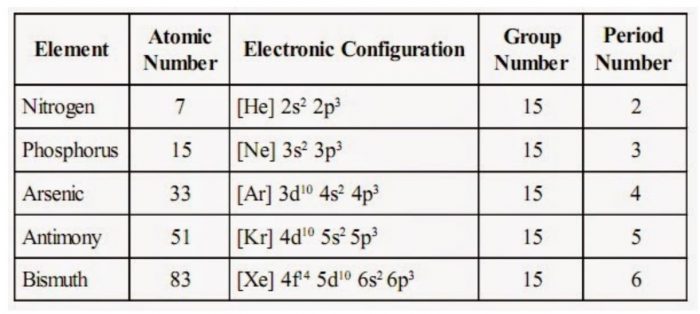
Chemical Properties: The group exhibits oxidation states of -3, +3, and +5, with a noted stability trend where the +3 state is more common for bismuth due to the inert pair effect. Nitrogen showcases distinct reactivity due to its small size and high electronegativity, leading to the formation of unique π-bonds (as in N₂). It reacts with hydrogen to form numerous hydrides, and with oxygen and halogens to yield a variety of oxides and halides, establishing it as a pivotal element in industrial chemistry.


This family encompasses Oxygen (O), Sulphur (S), Selenium (Se), Tellurium (Te), and Polonium (Po) with a general electronic configuration of ns² np⁴. Here too, oxygen remains a gas while the others are solids, exhibiting an increase in metallic character down the group.
Chemical Properties: Group 16 elements predominantly show oxidation states of -2, +2, +4, and +6. They are known for their ability to catenate, particularly sulfur. Their hydrides, such as water (H₂O) and hydrogen sulfide (H₂S), display varying thermal stabilities and acid strengths. Oxygen forms notable oxides like SO₂ and SO₃, demonstrating acidity and varying reactivity based on its oxidation states.
Comparison of Hydrides: A comparative glance at the bonding angles and basicity of compounds across the groups reveals the trend of diminishing stability downward each group.
In summary, the properties of p-block elements highlight a defined shift from non-metals to metals as you move down the group, with nitrogen and oxygen displaying distinctive behaviors due to their atomic sizes and electronegativities.