
Loading the lesson
Loading the lesson
Search AllRounder.ai
Search the courses, subjects, tracks, games and features, or jump straight to a page.
Search the courses, subjects, tracks, games and features, or jump straight to a page.
Learn it your way
A short class with Sarah and her students. The other ways are under More.
Sign up free to listen. Transcripts are free to read.

Today, we will explore minerals and ores. Can anyone tell me what minerals are?

Are they just rocks that contain metals?
Great point! Minerals are indeed naturally occurring substances that contain metals, but not all minerals are profitable to extract. That’s why we focus on ores, which are minerals from which metals can be extracted profitably.

What's the difference between ores and gangue?
That’s an important distinction! Gangue refers to the impurities such as sand and clay found in ores that need removal during processing.

Now, let's look at the different types of ores. Can anyone name a few?

I think there's oxide ores like haematite?
Exactly! Oxide ores like haematite, which contains Fe₂O₃, are just one type. We also have carbonate and sulphide ores. Who can tell me an example of a carbonate ore?

Isn't calcite a carbonate ore?
Yes! Well done. Knowing the types of ores helps us understand how they are processed for metal extraction.
Let's discuss gangue. Why do we need to remove gangue from ores?
To get more metal from the ore?
Exactly! By concentrating the ore, we increase the yield of metals. Can anyone suggest a method used for concentrating ores?
I heard about hydraulic washing.
Correct! Hydraulic washing capitalizes on density differences to separate gangue from the ore.
Today we'll also touch on the industrial relevance of different ores. Why do you think understanding ore types is important?
Because different metals have different uses?
Exactly! For instance, iron from haematite is vital for construction, while aluminium from bauxite is key in manufacturing aircraft.
So, is that why we study these ores?
Definitely! It’s crucial for everything from designing processes to understanding market demands.
Minerals shine and ores are fine, gangue is just a dirty line.
Imagine a treasure hunter who finds a shiny mineral but must sift through the dirt (gangue) to find the gold ore that makes the adventure worthwhile.
Remember 'O C S H' for types of ores: Oxide, Carbonate, Sulphide, Halide.
MOG to remember that Minerals Occur in Gangue.
Term
What are ores?
Click to flip
Term
What is gangue?
Click to flip
Term
Example of an oxide ore?
Click to flip
Term
Example of a carbonate ore?
Click to flip
Naturally occurring substances that contain metals.
Minerals that can be extracted profitably for metal production.
The impurities present in ore that must be removed during processing.
Ores primarily composed of metal oxides.
Ores that contain metals in the form of carbonates.
Ores containing metal sulfides.
Ores composed mainly of halides.
This section covers the occurrence of metals in nature, describing various mineral types, concentration methods, and the significance of mining operations.
Metals primarily exist as minerals and ores, involving lower-grade materials like gangue. Various methods, including hydraulic washing and magnetic separation, are employed to concentrate ores before extraction processes such as reduction and refining are performed.
Metals hold essential roles in our everyday lives, from electrical wiring to construction materials. However, very few exist in their pure forms in nature. This section delves into the natural sources of metals, categorized mainly into minerals and ores, with a focus on their extraction and purification processes. 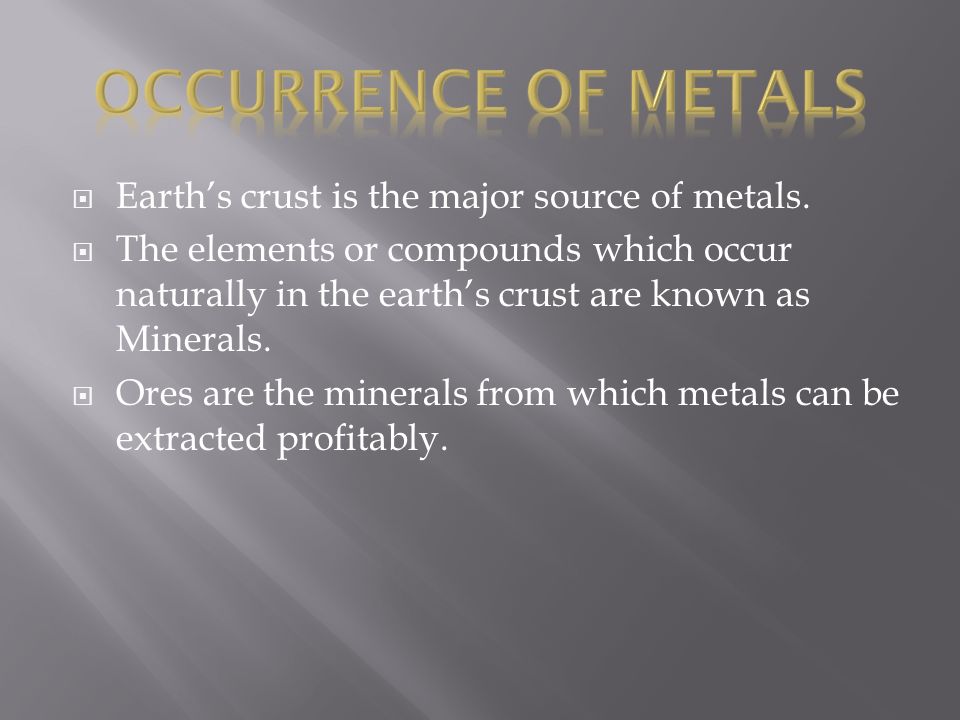
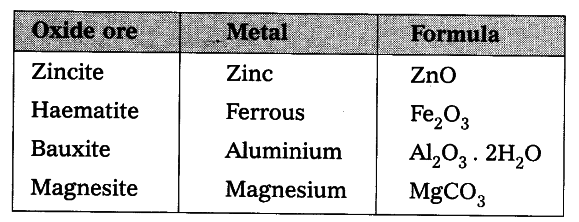
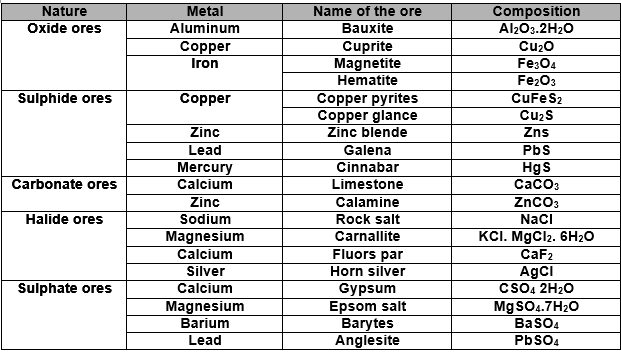
This foundational understanding serves as a stepping stone for studying the metallurgical processes that follow, emphasizing the connection between raw materials and modern metal production.