Loading the lesson
Loading the lesson
Search AllRounder.ai
Search the courses, subjects, tracks, games and features, or jump straight to a page.
Search the courses, subjects, tracks, games and features, or jump straight to a page.
Learn it your way
A short class with Sarah and her students. The other ways are under More.
Sign up free to listen. Transcripts are free to read.

Today, we’re diving into the concept of adsorption. Can anyone define what adsorption is?

Isn’t it when molecules accumulate on a surface?
Exactly! Adsorption is the accumulation of molecules, known as adsorbates, on a surface, which we call the adsorbent. It's important for processes such as catalysis and filtration. Can you think of anyone daily applications?

Like how water filters work?
Good example! Now, adsorption can be classified into two types: physical and chemical adsorption. Can anyone tell me a key difference between the two?

Is it about the forces involved?
Spot on! Physical adsorption involves weak van der Waals forces, while chemical adsorption involves the formation of chemical bonds. Remember the mnemonic 'Physisorption is Weak (PW) and Chemisorption is Strong (CS).' Can you recall some factors affecting adsorption?

Surface area and temperature, right?
Absolutely! We also include the nature of the adsorbate and adsorbent, pressure, and the activation of adsorbents. Great work! Let’s summarize key points: Adsorption is the accumulation of adsorbates on adsorbents, with physical and chemical types, influenced by several factors.

Now, let's discuss adsorption isotherms. What do you think they represent?
Is it how much gas is absorbed at different pressures?
Right again! Adsorption isotherms graphically show the relationship between gas adsorption and pressure at constant temperature. One example is the Freundlich adsorption isotherm. Can anyone give me the equation?
It's x/m = kP^(1/n)!
Correct! Here, x is the mass of the adsorbate, m is the mass of the adsorbent, P is the pressure, and k and n are constants. Understanding this allows us to predict how gases behave at different pressures. Let’s summarize: Adsorption isotherms illustrate the relationship between gas adsorption and pressure. The Freundlich equation helps us quantify this relationship.
Next, we’re moving on to catalysis! Can someone explain what a catalyst does?
It speeds up reactions, right?
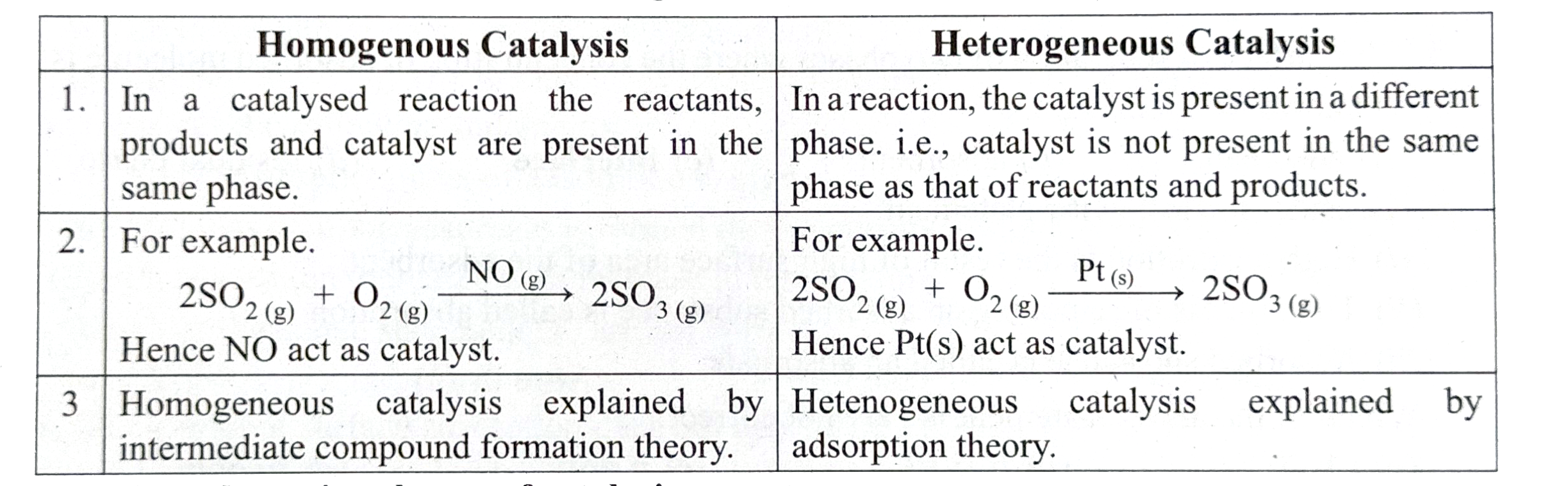
Exactly! A catalyst increases the rate of a chemical reaction without being consumed. Can anyone differentiate between homogeneous and heterogeneous catalysis?
Homogeneous is when they’re in the same phase, and heterogeneous is in different phases.
Correct! That’s an important distinction. Remember the acronym 'Homo Same, Hetero Different' (HSHD). Catalysts can also be affected by promoters, which increase activity, and poisons, which decrease it. What’s an example of a promoter?
Molybdenum in the Haber process?
Exactly! So, key summary: Catalysis increases reaction rates; we have homogeneous and heterogeneous types, with effects from promoters and poisons.
Let’s delve into the mechanism of catalysis. What happens when reactants meet a catalyst?
They get adsorbed on the catalyst surface?
Exactly right! They adsorb onto the catalyst surface, the reaction occurs, and then products are desorbed. It’s a cyclic process. Can anyone summarize the steps?
Well done! This is crucial in industrial applications. So remember, the catalyst is key to speeding up reactions by facilitating the process through these steps.
Finally, we’re on to colloids. What defines a colloid?
It’s a heterogeneous mixture with one substance finely divided in another!
Correct! Colloids can be classified based on their dispersed phase and medium. Can someone give examples of colloidal systems?
Like fog or gel?
Exactly! Fog is an aerosol, and jelly is a gel. Colloids have unique properties such as the Tyndall effect and Brownian motion. What’s the Tyndall effect?
The scattering of light by colloidal particles!
Excellent! Summarizing, colloids are heterogeneous mixtures with unique properties that can be classified in various ways. They are essential in many applications, such as emulsions, which are mixtures of two liquids.
Accumulation of molecules on a surface.
Weak adsorption, reversible.
Strong adsorption, often irreversible.
A substance that accelerates reactions without being consumed.
Heterogeneous mixtures of fine particles in a medium.
Light scattering by colloidal particles.
Adsorption gathers, both weak and strong, on surfaces they belong.
Once upon a time, in a factory, the catalyst was the hero, speeding up every reaction without ever being consumed, helping everyone work together smoothly.
Powers in Adsorption: 'Physisorption is Weak and Reversible (PW), Chemisorption is Strong and Irreversible (CS)'.
CATS - Catalysts Accelerate The Speed of reactions.
Term
What is adsorption?
Click to flip
Term
Define colloid.
Click to flip
Term
What is a catalyst?
Click to flip
Term
What is physisorption?
Click to flip
The process of molecules accumulating on the surface of a solid or liquid.
Weak adsorption involving van der Waals forces, often reversible.
Strong adsorption involving the formation of chemical bonds, typically irreversible.
A substance that increases the rate of a chemical reaction but remains unchanged.
A heterogeneous mixture with fine particles distributed within another substance.
A type of colloid where both dispersed phase and dispersion medium are liquids.
The scattering of light by colloidal particles.
The random zigzag motion of particles in a fluid.
Surface Chemistry examines the interactions at the interfaces of different phases, focusing on adsorption, catalysis, and colloids.
This section explores the principles of Surface Chemistry, emphasizing key concepts such as adsorption, the mechanisms of catalysis, and colloidal systems. Understanding these concepts is vital for their applications in various industrial processes and everyday life.
Surface Chemistry is a vital area of chemistry focused on interactions occurring at the interfaces of different phases, particularly solid-liquid, solid-gas, and liquid-gas. It involves three main concepts: adsorption, catalysis, and colloids, each playing significant roles in various processes.
Adsorption is defined as the accumulation of molecules, known as the adsorbate, on the surface of a solid or liquid, referred to as the adsorbent, forming a thin film. There are two primary types:
![Physisorption and chemisorption processes. Reproduced from ref [42]. | Download Scientific Diagram](https://www.researchgate.net/publication/384936653/figure/fig1/AS:11431281421317170@1746327569255/Physisorption-and-chemisorption-processes-Reproduced-from-ref-42.png)
Factors affecting adsorption include the nature of both the adsorbent and adsorbate, the surface area of the adsorbent, temperature effects, and pressure, especially for gases. Adsorption isotherms, such as the Freundlich Adsorption Isotherm, graphically depict the relationship between gas adsorption and pressure.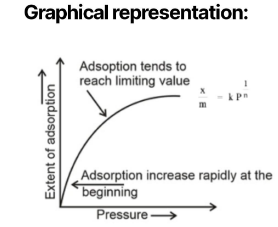
Catalysis is the acceleration of a chemical reaction through a catalyst, which remains unchanged. It can occur in two forms:
A colloid is a heterogeneous mixture in which fine particles (dispersed phase) are distributed within another substance (dispersion medium). Colloids are classified based on the physical state of the dispersed phase and dispersion medium, their interactions, and the type of particles involved. Properties of colloids, such as the Tyndall effect and Brownian motion, are important for their behavior and applications. Special forms of colloids include emulsions, which are mixtures of two liquids.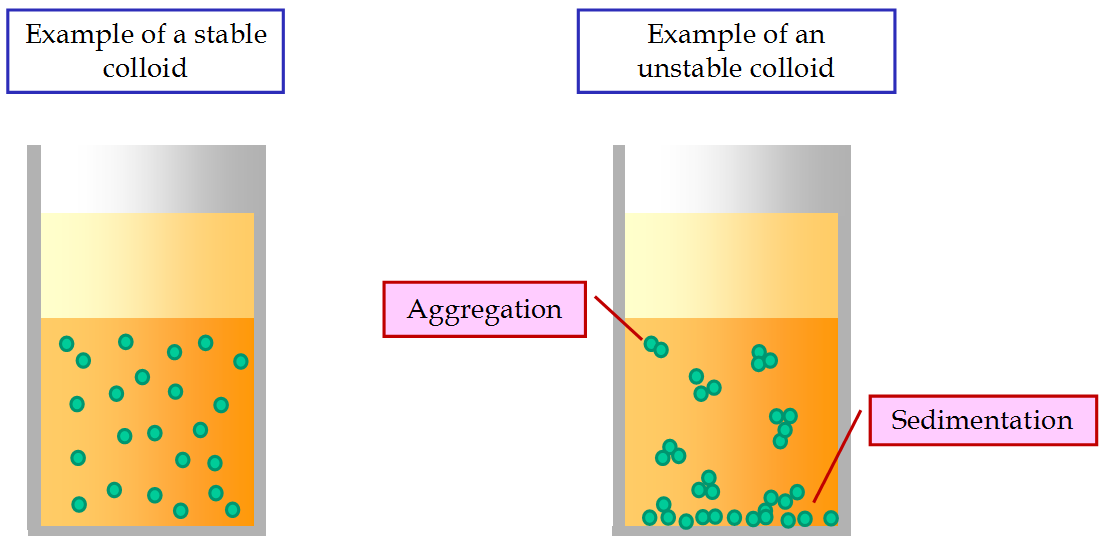
In conclusion, Surface Chemistry encompasses crucial processes that enhance our understanding of material behaviors and their applications in numerous industrial and daily contexts.