
Loading the lesson
Loading the lesson
Search AllRounder.ai
Search the courses, subjects, tracks, games and features, or jump straight to a page.
Search the courses, subjects, tracks, games and features, or jump straight to a page.
Learn it your way
A short class with Sarah and her students. The other ways are under More.
Sign up free to listen. Transcripts are free to read.

Today, we are going to explore the classification of alcohols. Can anyone tell me how we can classify alcohols?

Is it by the number of hydroxyl groups?
Exactly, Student_1! Alcohols can be classified based on the number of –OH groups. We have monohydric, dihydric, and trihydric alcohols. Can anyone give me examples of each?

Ethanol for monohydric, ethylene glycol for dihydric, and glycerol for trihydric!
Great job, Student_2! Now, who can tell me what 'monohydric' means?

It means it has one hydroxyl group, right?
That's correct! To remember that, you can think of 'mono' as 'one.' Let's think of a memory aid: 'One OH in mono, two in di, three in tri!'

So, monohydric has one –OH, dihydric has two, and trihydric has three! Got it!
Excellent! Now, let's move to the next classification based on the type of carbon atoms. What do you think that involves?

Now, let's classify alcohols based on the type of carbon atom the –OH group is attached to. Can anyone tell me the three types?
Are they primary, secondary, and tertiary?
That's correct, Student_1! Primary alcohols have the hydroxyl group on a carbon attached to only one other carbon. Can anyone provide an example of a primary alcohol?
Ethanol again!
Right! For secondary alcohols, which alcohols can you think of?
Isopropanol is one.
Good job! And what about tertiary alcohols?
Tert-butanol!
Excellent! To remember these classifications, think of '1 for primary, 2 for secondary, and 3 for tertiary.' What are the structural characteristics of secondary and tertiary alcohols?
Why do you think it’s important to classify alcohols?
So we can understand their properties and reactions better?
Absolutely! The classification tells us how these alcohols behave in reactions. What can you deduce about the boiling points of dihydric and trihydric alcohols?
They would have higher boiling points due to more hydroxyl groups!
Exactly! More –OH groups mean stronger hydrogen bonding, leading to higher boiling points. Let's summarize what we've learned in today's sessions.
We learned about monohydric, dihydric, and trihydric alcohols and also primary, secondary, and tertiary classifications!
Correct! Understanding these classifications will greatly assist you in comprehension of alcohol-related reactions. Well done, everyone!
One hydroxyl group present.
Two hydroxyl groups present.
Three hydroxyl groups present.
Hydroxyl group on a carbon connected to one carbon.
Hydroxyl group on a carbon connected to two carbons.
Hydroxyl group on a carbon connected to three carbons.
One OH for mono, two for di, three for tri!
Imagine three brothers: Mono, Di, and Tri, each with a different number of friends - one, two, and three, representing the –OH groups in alcohols.
To remember primary, secondary, tertiary: 'One friend, two friends, three friends!'
M-D-T for Monohydric, Dihydric, Trihydric.
Term
What is a monohydric alcohol?
Click to flip
Term
What characterizes tertiary alcohols?
Click to flip
An alcohol that contains one hydroxyl (-OH) group.
An alcohol that contains two hydroxyl (-OH) groups.
An alcohol that contains three hydroxyl (-OH) groups.
An alcohol where the hydroxyl group is attached to a carbon atom that is connected to only one other carbon.
An alcohol where the hydroxyl group is attached to a carbon atom that is connected to two other carbons.
An alcohol where the hydroxyl group is attached to a carbon atom that is connected to three other carbons.
This section introduces the classification of alcohols based on the number of hydroxyl groups and the type of carbon atom they are attached to.
Alcohols can be categorized into monohydric, dihydric, and trihydric based on the number of hydroxyl groups present. Additionally, they can be classified as primary, secondary, or tertiary depending on the carbon atom's connectivity to other carbon atoms. This classification is essential for understanding their nomenclature, properties, and reactions.
In organic chemistry, alcohols are classified based on two key criteria: the number of hydroxyl groups attached to their structure and the type of carbon atom to which these groups are attached.
1. Classification by Number of –OH Groups:
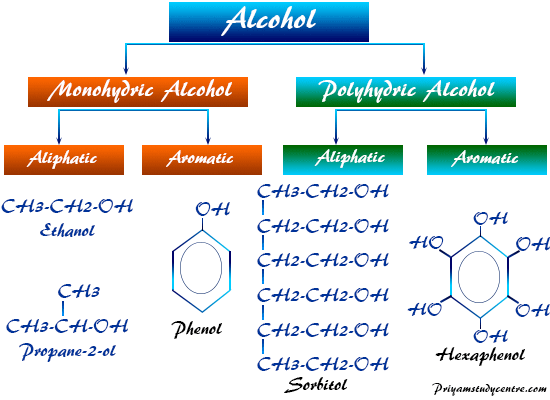
2. Classification by Type of Carbon:
Understanding these classifications is crucial for the nomenclature, behavior, and utility of alcohols in various organic reactions, making it an essential aspect of organic chemistry.