Loading the lesson
Loading the lesson
Search AllRounder.ai
Search the courses, subjects, tracks, games and features, or jump straight to a page.
Search the courses, subjects, tracks, games and features, or jump straight to a page.
Learn it your way
A short class with Sarah and her students. The other ways are under More.
Sign up free to listen. Transcripts are free to read.

Today, we begin exploring the solid state. Can anyone tell me about the characteristics that define solids?

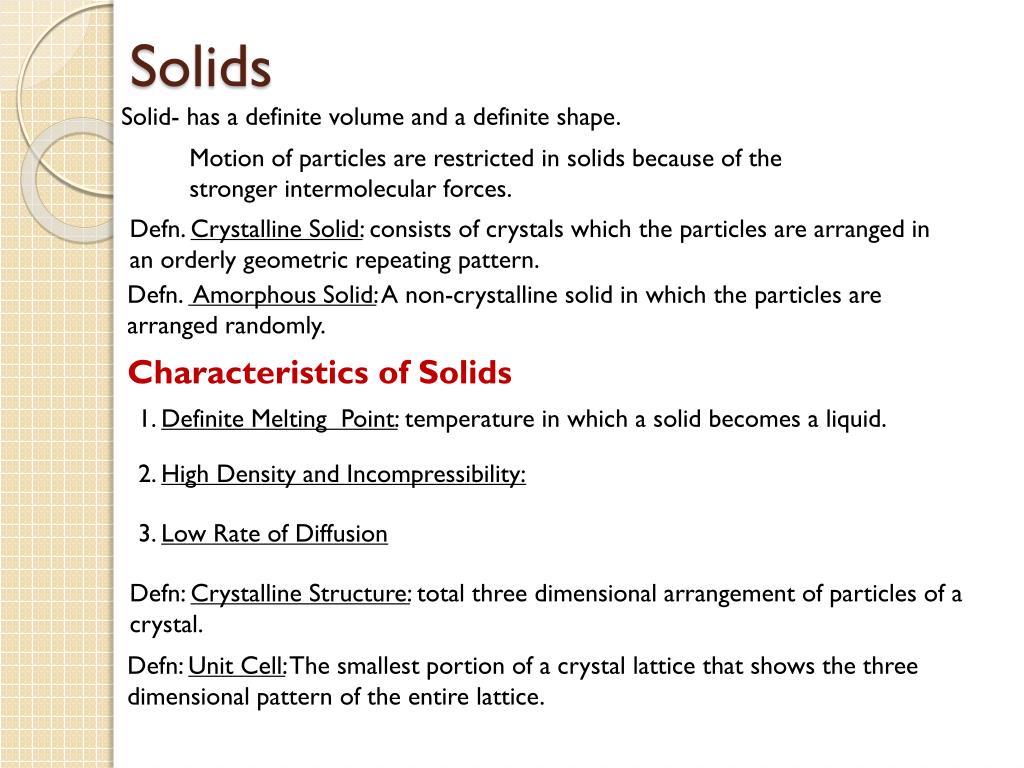
Solids have a definite shape and volume.
Excellent! Yes, solids maintain a fixed shape and volume. This rigidity arises from strong intermolecular forces. Can anyone explain what incompressibility means?

It means that solids cannot be squeezed into a smaller volume because the particles are so tightly packed.
Exactly! Remember the acronym 'SHARE' — Solid, High density, A definite shape, Rigid, and Essentially incompressible. Let's move on—who can tell me about the kinetic energy in solids?

The particles have low kinetic energy; they just vibrate in place instead of moving freely.
Correct! These characteristics are what make solids distinct compared to the other states. To summarize, solids are rigid, incompressible, and have a high density due to tightly packed particles.

Now, let's dive into the classification of solids. Can anyone name the two main categories of solids?

Crystalline and amorphous!
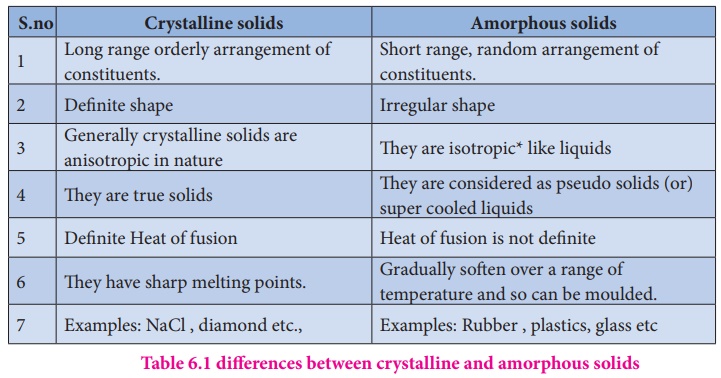
Great memory! Let's differentiate them. Who can explain the structure of crystalline solids?
Crystalline solids have a regular and well-defined arrangement of particles.
Exactly! And they have sharp melting points. Now, can someone describe amorphous solids?
They have an irregular arrangement of particles and do not have a definite melting point. They gradually soften.
Exactly! Remember: 'Clarity means clarity in crystalline, while messy is amorphous.' In summary, crystalline solids are structured, whereas amorphous solids are more random in their particle arrangement.
We've established the two categories, now let's understand the types of crystalline solids. Who can name one type and give a brief explanation?
Ionic solids! They are made up of positive and negative ions and have strong electrostatic forces.
Well explained! These solids are typically hard and brittle. How about another type?
Covalent solids, like diamond. They are very hard and made of atoms connected by covalent bonds.
Correct! Now, what about metallic solids?
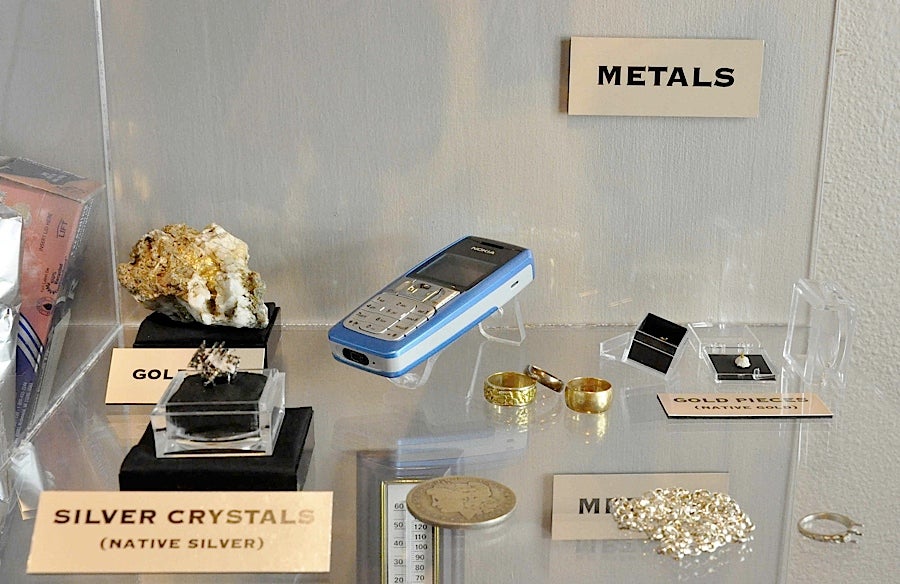
They are composed of positive metal ions surrounded by free electrons, making them good conductors of electricity.
Fantastic! Let's not forget molecular solids; they are held together by weaker forces like Van der Waals forces. As a summary, we classify crystalline solids into ionic, covalent, molecular, and metallic.
Solids are defined by their definite shape and volume.
crystalline and amorphous.
Crystalline solids have a structured arrangement, while amorphous solids have an irregular structure.
Types of crystalline solids include ionic, covalent, molecular, and metallic solids.
In solids tight and fair, particles don't go anywhere.
Once upon a time in a kingdom of matter, solids stood tall and proud, never changing shape, creeping slowly like the quiet, stubborn mountains, while liquids danced around them.
SLIM for solids: Solid, Low energy, Incompressible, Maintain shape.
CAMS for types of crystalline solids: Covalent, Amorphous, Molecular, and Salt.
Term
What are the characteristics of solids?
Click to flip
Term
Name the two main types of solids.
Click to flip
Term
What is an example of an ionic solid?
Click to flip
Term
What defines a covalent solid?
Click to flip
A state of matter characterized by definite shape and volume due to tightly packed particles.
Solids with a well-defined, ordered arrangement of particles.
Solids that lack a clear structure and do not have a sharp melting point.
A type of crystalline solid made up of positive and negative ions held together by ionic bonds.
A type of crystalline solid formed by atoms linked by covalent bonds.
Solids made from molecules held together by weaker forces.
Solids composed of metal ions surrounded by a sea of delocalized electrons.
This section explores the characteristics, types, and properties of solids, emphasizing their rigid structure in comparison to liquids and gases.
The solid state of matter is defined by its rigidity and fixed shape and volume due to the tight packing of particles. Solids are classified into crystalline and amorphous types, with crystalline solids further divided based on their bonding. Understanding these characteristics is essential for grasping the unique roles solids play in everyday life.
This chapter initiates the exploration of matter in its three fundamental states: solid, liquid, and gas, focusing primarily on the solid state. Solids are characterized by their definite shape and volume, attributed to the tightly packed particles that lead to rigidity, high density, and incompressibility. In this section, we will discuss the general characteristics of solids, classify solids into crystalline and amorphous types, examine the differences between these categories, and delve into the types of crystalline solids based on bonding forces.