
Loading the lesson
Loading the lesson
Search AllRounder.ai
Search the courses, subjects, tracks, games and features, or jump straight to a page.
Search the courses, subjects, tracks, games and features, or jump straight to a page.
Learn it your way
A short class with Sarah and her students. The other ways are under More.
Sign up free to listen. Transcripts are free to read.

Let's start with the decline of the Mughal Empire. Can anyone tell me what happened after Aurangzeb died in 1707?

The emperors after him were weak and controlled by noble families, right?
Exactly! These weak successors struggled to uphold the empire's authority. This leads us to our acronym "WINEP" — Weak successors, Internal rivalries, eNlarged empire, Economic decline, and Peasant revolts. Can someone explain what we mean by economic decline?

The empire was spending more money than it was making due to wars and heavy taxation.
Right! Heavy taxation led to peasant revolts, which further destabilized the empire. Great job connecting those dots.

Now, let's look at the independent kingdoms that emerged. Who can name some of those kingdoms?

There were kingdoms like Hyderabad, Awadh, and Bengal, right?
Exactly! Each kingdom had its unique strengths. Let's explore Hyderabad. Who founded it?

Nizam-ul-Mulk Asaf Jah founded it in 1724.
Correct! Hyderabad became a cultural and trading center. How about Awadh, what made it prosperous?
It thrived due to agriculture and had a very rich economy.
Perfect! Opportunities and rich resources became a hallmark of these kingdoms during the Mughal decline.
Moving on, how did European powers play into this backdrop of regional change?
They were trying to trade, but they started taking part in politics and wars too.
Right! The Portuguese were the first, but by the 18th century, the British and French were the key players. What were the Carnatic Wars about?
They were conflicts between the British and French for control in India.
Exactly! This rivalry allowed the British to emerge as the dominant power. Anyone know how many Carnatic Wars there were?
There were three main wars!
Great job! Understanding this rivalry is essential to grasping how colonial powers established control in India.
Marked by weak successors, internal rivalries, and economic decline.
Various independent kingdoms arose as central authority weakened.
European trading companies increased their political involvement through conflicts like the Carnatic Wars.
When Mughals fell, chaos rang, with kingdoms rose, and power sang.
Imagine a grand empire, like a once-mighty tree, now shedding leaves as ambitious little kingdoms sprout in its shade.
WINEP - Weak successors, Internal rivalries, enlarged empire, Economic struggles, Peasant revolts.
ELECT - East India companies, Local leaders, Economic turmoil, Conflicts, Transition to colonialism.
Term
What caused the decline of the Mughal Empire?
Click to flip
Term
Who founded the independent kingdom of Hyderabad?
Click to flip
A centralized empire in India that existed from the early 16th century to the 18th century, known for its cultural, architectural, and administrative achievements.
The last major Mughal emperor, whose death in 1707 marked the beginning of the empire's decline.
A historical title for a governor or sovereign in India during the Mughal era.
Companies established by European nations, like the British East India Company and the French East India Company, to facilitate trade in India and influence local politics.
A series of military conflicts between the British and French in India during the 18th century, which resulted in British dominance.
The 18th century marked a significant transition in India, characterized by the decline of the Mughal Empire and the rise of regional kingdoms amidst increasing European influence.
In the 18th century, India experienced the decline of the Mughal Empire following Aurangzeb's death, leading to the emergence of regional powers such as Hyderabad, Awadh, and Bengal. Concurrently, European trading companies, notably the British and French, began asserting their political influence through military conflicts like the Carnatic Wars, establishing conditions for eventual British colonial dominance.
The 18th century was a transformative period in Indian history, primarily marked by the decline of the once-mighty Mughal Empire, which had dominated the subcontinent. Following the death of Emperor Aurangzeb in 1707, the empire faced a series of internal and external challenges that led to its fragmentation. Key causes of decline included incompetent successors, internal rivalries among Mughal nobility, administrative difficulties due to the vastness of the empire, economic woes, peasant revolts due to heavy taxation, and invasions from external forces like Nadir Shah and Ahmad Shah Abdali.
As Mughal authority weakened, various regional kingdoms emerged, including Hyderabad under Nizam-ul-Mulk, Awadh, Bengal, the Marathas, Sikhs, Jats, and Rajputs. These independent kingdoms capitalized on the power vacuum, contributing to significant political fragmentation in the region.
While local powers gained influence, European trading companies such as the Portuguese, Dutch, French, and British began to expand their reach. By the mid-18th century, the British East India Company had positioned itself as a dominant force through military victories against rival companies and Indian rulers, notably in the Carnatic Wars. This series of conflicts not only established British supremacy but also laid the groundwork for colonial rule in India.
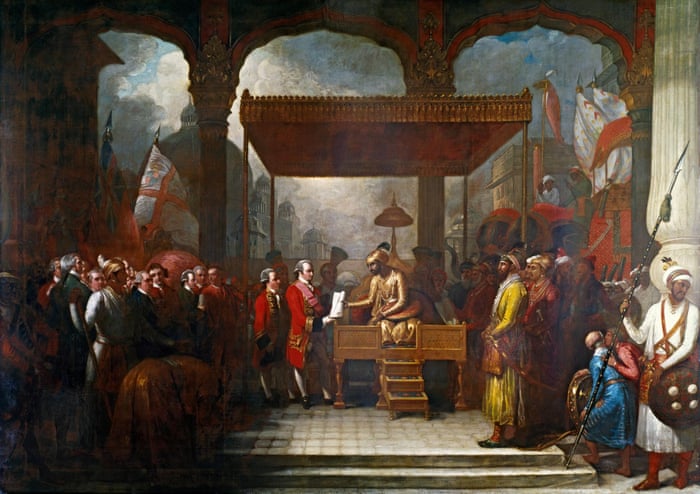
Overall, the 18th-century developments were crucial in transitioning India from a fragmented collection of principalities to a key battleground for European powers, eventually ushering in the era of the British Empire.