
Loading the lesson
Loading the lesson
Search AllRounder.ai
Search the courses, subjects, tracks, games and features, or jump straight to a page.
Search the courses, subjects, tracks, games and features, or jump straight to a page.
Learn it your way
A short class with Sarah and her students. The other ways are under More.
Sign up free to listen. Transcripts are free to read.

Let's begin with the basics. An algorithm is a step-by-step procedure for solving a problem. Can anyone explain why algorithms are important in programming?

They help in organizing the steps we need to take to solve a problem.
"Exactly! A good algorithm should have several features—like finiteness, definiteness, and the ability to take inputs and produce outputs.

Now, let's transition to flowcharts. Who can tell me what a flowchart is?

It's a visual representation of an algorithm using symbols!
Exactly! Flowcharts help visualize logic and can make error identification easier. Can anyone name some common symbols used in flowcharts?
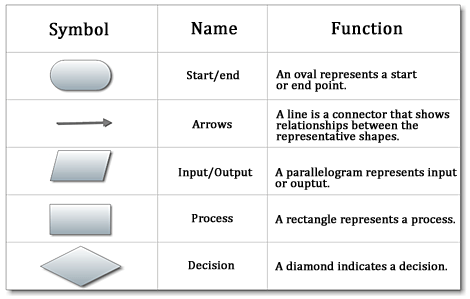
There's the oval for start and end, rectangles for processes, and diamonds for decisions!
Correct! Each symbol serves a unique purpose in mapping out the process. Let's draw a flowchart for checking if a number is even or odd. Who would like to help?

We can start with 'Input N', then ask if 'N mod 2 = 0' and branch out for 'Yes' or 'No'!
Great job! Remember to keep flowcharts clean and straightforward for clarity. To summarize, flowcharts provide a visual way to understand processes, making coding easier.
Let's discuss the differences between algorithms and flowcharts. How does an algorithm differ from a flowchart?

An algorithm is written in text while a flowchart is a diagram!
Exactly! Algorithms can sometimes be lengthy and harder to visualize, while flowcharts offer a more intuitive understanding. Let's review some advantages. What are the benefits of using algorithms?
They're easy to understand, don't require programming knowledge, and help with debugging.
Great points! And flowcharts provide better visual understanding! However, both can have limitations, like being complex when representing lengthy logic or requiring a redraw for changes. In conclusion, both tools complement each other in programming.
A clear step-by-step process to solve a problem.
A diagrammatic representation of an algorithm using symbols.
The property ensuring that an algorithm ends after a set number of steps.
Each step in an algorithm must be unambiguous.
Data that an algorithm accepts.
Results that an algorithm produces.
Steps should be basic enough for execution.
A flowchart starts, with oval shapes, to show the flow from one step to another's fate.
Once, in code-land, a wizard used steps to find treasures. He wrote instructions and drew paths (flowcharts), guiding everyone safely to their gold.
FIDE - Features of a good algorithm: Finiteness, Definiteness, Input, Output, Effectiveness.
DICE for flowchart symbols: Diamond for decisions, Input/output, Circle for start/end, and Rectangle for processes.
Term
Algorithm
Click to flip
Term
Flowchart
Click to flip
Term
Finiteness
Click to flip
Term
Input/Output
Click to flip
A step-by-step procedure for solving a problem.
A diagrammatic representation of an algorithm using symbols.
The feature that ensures an algorithm ends after a specific number of steps.
The unambiguous nature of each step in an algorithm.
Data accepted by an algorithm.
The results produced by an algorithm.
Characteristics of the steps in an algorithm that are basic enough to carry out.
Algorithms and flowcharts are crucial tools for problem-solving in programming, allowing for clear logical planning before coding.
This section covers the definitions and features of algorithms and flowcharts, emphasizing their benefits in programming. It explains the components of both, how to construct them, and the differences between the two, while providing practical examples and guidelines to enhance understanding.
In the realm of computer science, algorithms and flowcharts serve as foundational tools for organizing and solving problems logically. An algorithm is defined as a step-by-step procedure for resolving a specific issue or task. Key characteristics of a good algorithm include finiteness, definiteness, input and output capacity, and effectiveness.
For example, the algorithm to find the sum of two numbers consists of reading the numbers, adding them, and displaying the result.

A flowchart, on the other hand, offers a visual representation of an algorithm using standardized symbols. This graphical approach aids in understanding and debugging the logic of a program. Common symbols used in flowcharts include:
While both tools are invaluable, they have distinct advantages and limitations. Algorithms are easier to write and modify but may be lengthy, while flowcharts facilitate visual understanding but can become complicated when depicting complex logic. Ultimately, mastering these tools lays the groundwork for efficient programming and problem-solving.