
Loading the lesson
Loading the lesson
Search AllRounder.ai
Search the courses, subjects, tracks, games and features, or jump straight to a page.
Search the courses, subjects, tracks, games and features, or jump straight to a page.
Learn it your way
A short class with Sarah and her students. The other ways are under More.
Sign up free to listen. Transcripts are free to read.

Today, we're going to explore how to write a kernel module that interfaces with a ranging sensor. Can anyone tell me what a kernel module is?

Is it a piece of code that can be loaded into the kernel to extend its functionality?
Exactly! Kernel modules help in adding features like device drivers without needing to reboot the system. They connect user applications with hardware. Who can name a real-world application of this?

Using a sensor to measure distances, like in robotics or automation?
Right! Now, let's get into our specific example of an ultrasonic sensor.

In our kernel module, the first step involves initializing the GPIO pins. Can someone remind me what GPIO stands for?

General Purpose Input/Output!
Perfect! We need to ensure these are properly configured before we can read sensor data. What do we do first in the code?

We check if the GPIO pins are valid and then request them.
Correct! This avoids conflicts with other drivers and ensures clean operation. If the pins are invalid, what do we return?
An error code, like -ENODEV!
Next, we need to measure distance. Can anyone tell me the basic concepts involved in using an ultrasonic sensor?
It sends sound waves and measures the time it takes for the echoes to return!
Exactly! We calculate the time taken to echo back and apply the formula. What is the formula for that?
Distance equals time times the speed of sound divided by two!
That's right! Always remember to divide by two since the sound travels to the object and back.
Now let's talk about how user applications will interact with our kernel module. How can we expose the measured distance?
We can create a device file that user-space programs can read!
Great! This allows programs to access our measurement easily. What function do we use to implement this?
We override the 'read' function to handle the data transfer!
Correct! This way, the user space can simply call 'read' to get the current distance measurement immediately.
Finally, once we’re done with the module, we need to ensure we clean up properly. Why is this necessary?
To avoid memory leaks and free the resources we used!
Exactly! We unregister the device and free the GPIO. Can anyone remind us what functions we use?
We use 'gpio_free' for GPIO pins and 'unregister_chrdev' for the device!
Correct! Always maintain good coding hygiene to prevent future issues. Any questions?
Learning to develop modules that add functionalities to the Linux kernel.
Importance of properly configuring GPIO pins before use.
Methodology using time of flight of sound to calculate distance.
Techniques to expose sensor data to user applications via device files.
Essential practices for freeing resources and avoiding memory leaks.
To measure distanc
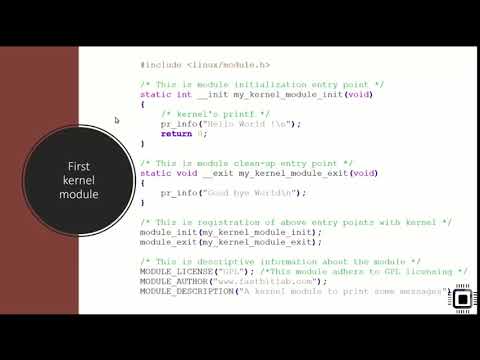
Linux device driver lecture 8 : Writing a kernel module and syntax
Embedded Linux | Configuring The Linux Kernel | Beginners

Linux Device Drivers Development Course for Beginnerse with great precision, send a pulse and count the condition.
Imagine a brave explorer sending out a sound wave, waiting for it to bounce back so they can know how far away the treasure is!
Remember the acronym 'DICE': Distance, Input Time, Calculate Echo.
GPIO - General Purpose Input/Output.
Term
Kernel Module
Click to flip
Term
Distance Calculation Formula
Click to flip
Term
Echo Pin
Click to flip
Term
Trigger Pin
Click to flip
A piece of code that can be loaded into the kernel to extend its functionality.
General Purpose Input/Output pins used to interface with hardware.
The GPIO pin that receives the echo signal from the ranging sensor.
The GPIO pin that sends a short pulse to trigger the sensor measurement.
Distance = (Time * Speed of Sound) / 2
This section provides detailed instructions for creating a kernel module that interacts with a ranging sensor on a Linux-based embedded system.
The section covers the step-by-step process of writing a kernel module for an ultrasonic ranging sensor, including code snippets for initializing GPIO pins, measuring distance, and exposing data to user applications. It emphasizes interaction with the hardware and proper resource management.
This section demonstrates the creation of a kernel module for a ranging sensor (specifically using the HC-SR04 ultrasonic sensor) that is integral to measuring distances in embedded systems. The implementation begins with including necessary headers for GPIO functionality and device management. The core functions outlined include:
Initialization of GPIO Pins: Utilizing the gpio_request function to set up trigger and echo pins for the sensor with appropriate error handling.
Distance Measurement Logic: Detailed performance of sending a pulse to trigger the sensor and using the duration of the echo to compute the distance based on the speed of sound.
User-Space Interaction: The module will expose the measured distance as a device file, allowing user applications to retrieve this data conveniently.
Resource Management: Proper cleanup of resources upon module removal to ensure there are no memory leaks or dangling pointers.
The provided code snippets and explanations serve to guide the user in effectively utilizing Linux kernel programming principles to build a practical and efficient sensor interface.